The Plumb Ledger · Vol. IFirst-party evidence · Est. 2026

Publisher reporting, minus the theatre

Crawler logs, read as evidence.

Plumb turns crawler logs, analytics, and referral traces into editorial evidence. See which agents are reading, which stories are being reused, and where a policy or commission should land.

window
14 days
bots
6 live
mode
publisher-owned

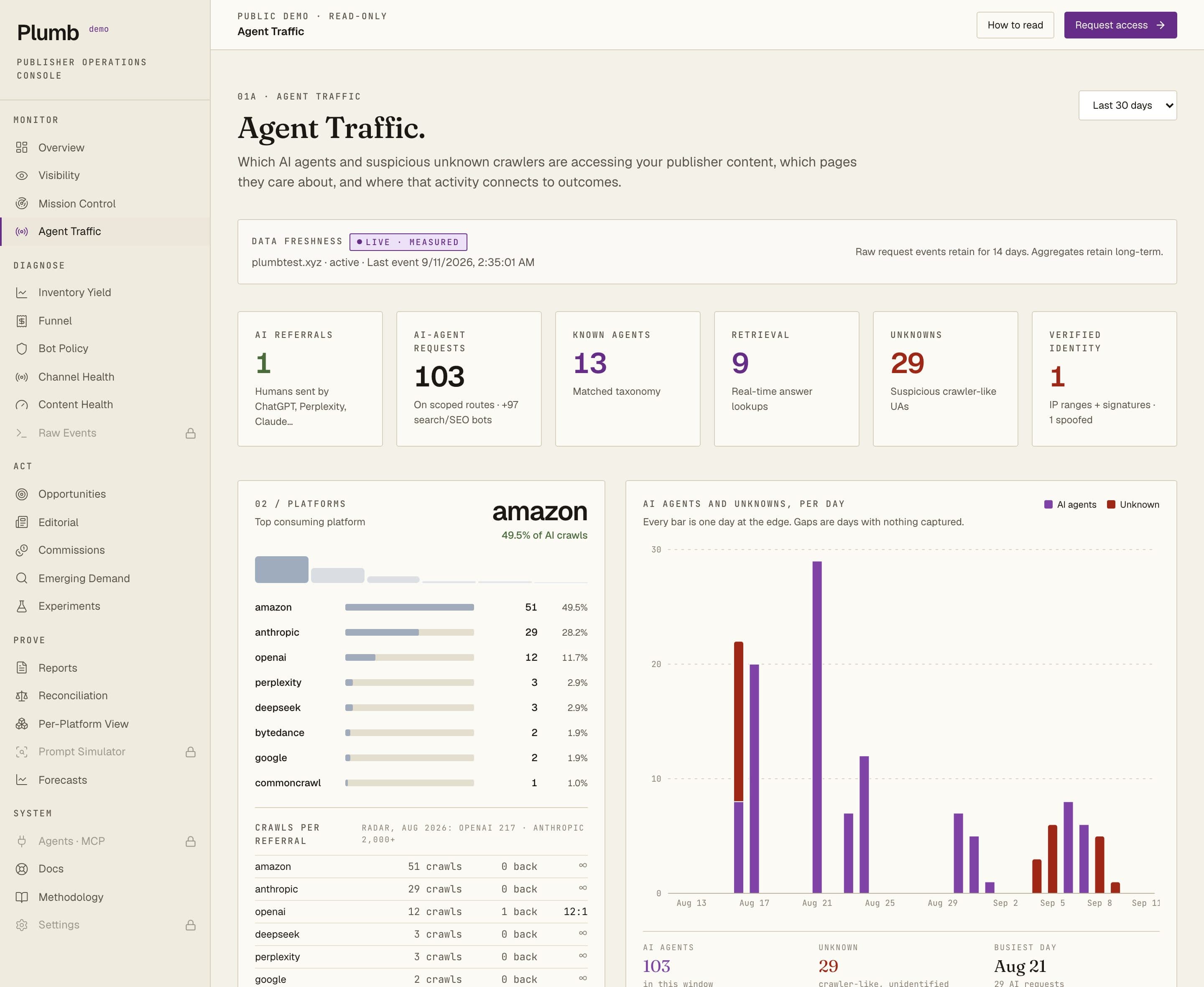
Fig. 1 — Crawler demand, 14-day trace

A living map of bot demand

measured
readingtoday · GPTBot
citation row34% CF · 1.4% Adobe
policy row5 active bot rules
counter4,010 req
043787413101747-13d-11d-9d-7d-5d-3d-1dtoday
top sourceGPTBot
volume, this day1,560
day-over-day+5.5%

Field note 01

AI consumption is already visible in your logs.

The point is not to celebrate the crawl. It is to turn the crawl into a line item your editorial, revenue, and policy teams can read in the same meeting.

Cloudflare34%

of origin requests are AI

edge logs / first-party evidence
Adobe Analytics1.4%

of sessions come from AI

analytics surface / lower than crawl volume
Plumb analysis24×

consumption-to-referral ratio

publisher-owned evidence trail

Workbench

A desk built around the data you already own.

Connect edge logs and analytics. Plumb shows crawler activity, referral gaps, and the evidence behind each recommendation before you change a policy or commission a story.

live feed12,847

origin requests per second

Origin requests / sec12,847+8.4%
Citation share (live)412.6%+12.1%
Active crawlers237+6

Bot demand · live request rows

14 days
DomainBotPathRequestsNote
crustwallet.comGPTBot/rates/crust1,284edge / allowed
deepdishrate.comClaudeBot/compare942citations rising
forcheese.comPerplexityBot/best-rates788sampled
pizzapedia.comGoogle-Extended/guides611reference heavy
creditcrust.comApplebot/premium/*402policy flagged

Field note 02

A request path, not a pitch deck.

Plumb sits where the request becomes evidence and the evidence becomes a report a publisher can act on.

  1. requestagent hit

    the crawler asks for a page, a segment, or a feed

  2. edgepolicy check

    the request passes through the publisher’s control point

  3. logfirst-party trace

    Cloudflare, Fastly, GSC, GA4, or server logs keep the trail

  4. Plumbreconciliation

    telemetry, citation share, and policy are normalized together

  5. reporteditorial brief

    the output lands as a decision-ready brief, not a dashboard

Meter · verify · commission

Measure, explain, act.

Plumb gives teams a shared read on crawler demand, referral gaps, and the next pieces worth fixing.

01

Meter anything in one line.

Connect Cloudflare, Fastly, or server logs. Plumb cleans the stream, groups crawler activity, and keeps the raw trail close enough to audit.

Read the integration guide
SourceDetailShare
Cloudflareorigin edge34%
Fastlycache misses22%
GSCsearch discovery18%
Server logsraw path hits100%

02

Verify before you act.

Label every metric by evidence tier: measured, sampled, or inferred. Teams can see what is fact and what is a model.

See confidence tiers
TierDetailSource
Measuredfirst-party tracelogs you own
Sampledprobe-backededge observations
Inferredmodeled relationshipPlumb analysis

03

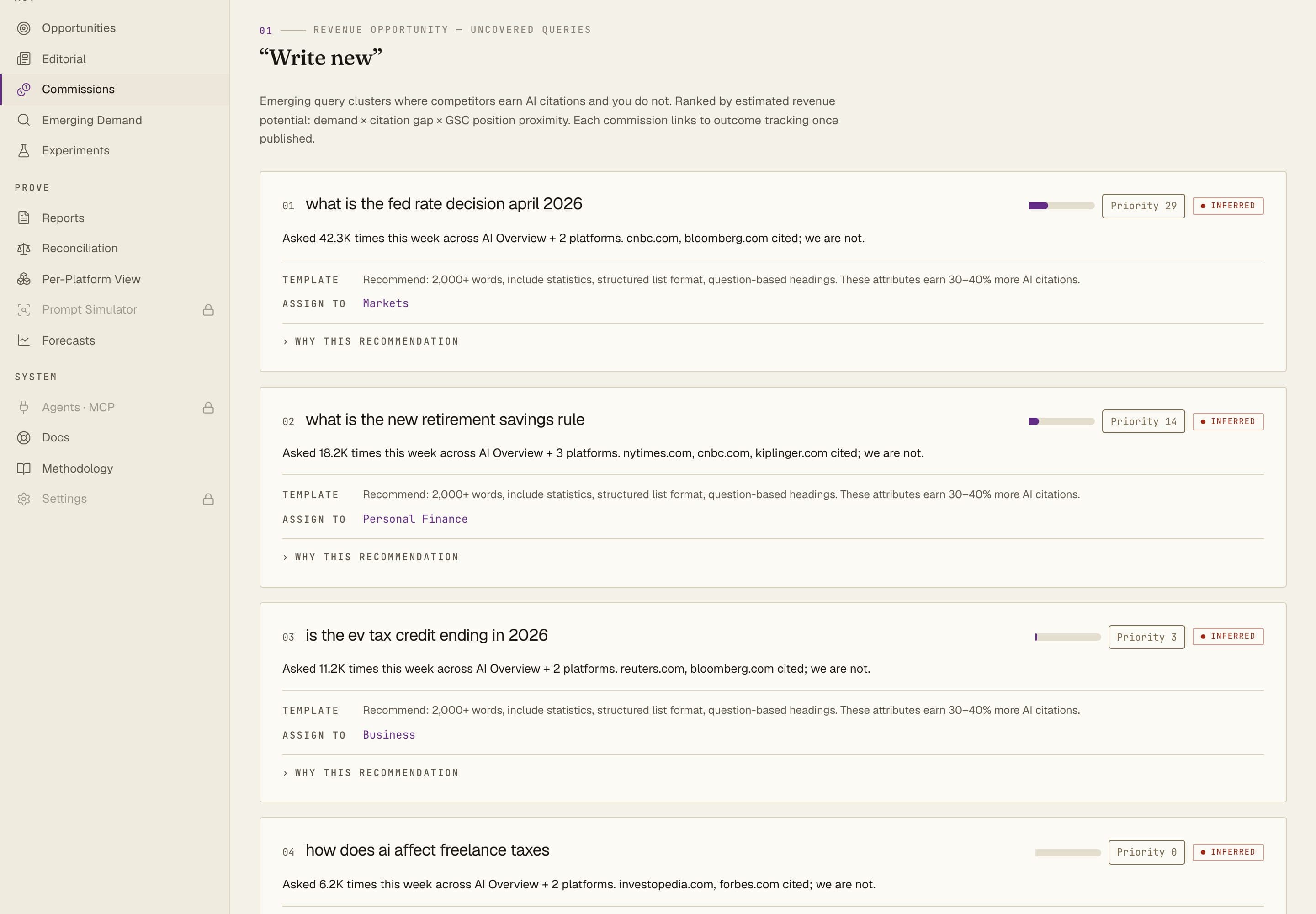
Commission from evidence.

Every recommendation points back to the evidence. When an editor asks “why this?”, the answer is already attached.

Browse commission engine
BRIEF-04210

commission queue

Refresh$4K/yr
BRIEF-04211

commission queue

Retire$2.8K/yr
BRIEF-04212

commission queue

Update$6.2K/yr
BRIEF-04213

commission queue

New$12K/yr

Agent access

Plumb speaks MCP.

Every table, meter, and commission workflow in Plumb is also a tool call. Point Claude, Cursor, or your own agent at Plumb and ask the same questions your editorial desk does.

MCP

Fifteen tools, five resources, one token.

Mint a scoped token from the dashboard, drop it into your MCP client, and ask “what should I commission this week?” Plumb pulls bleeding queries, drafts the brief, and cites the evidence tier behind every claim.

{
  "mcpServers": {
    "plumb": {
      "command": "plumb-mcp",
      "env": { "PLUMB_MCP_TOKEN": "plumb_mcp_…" }
    }
  }
}
Open the MCP console
NameKindReturns
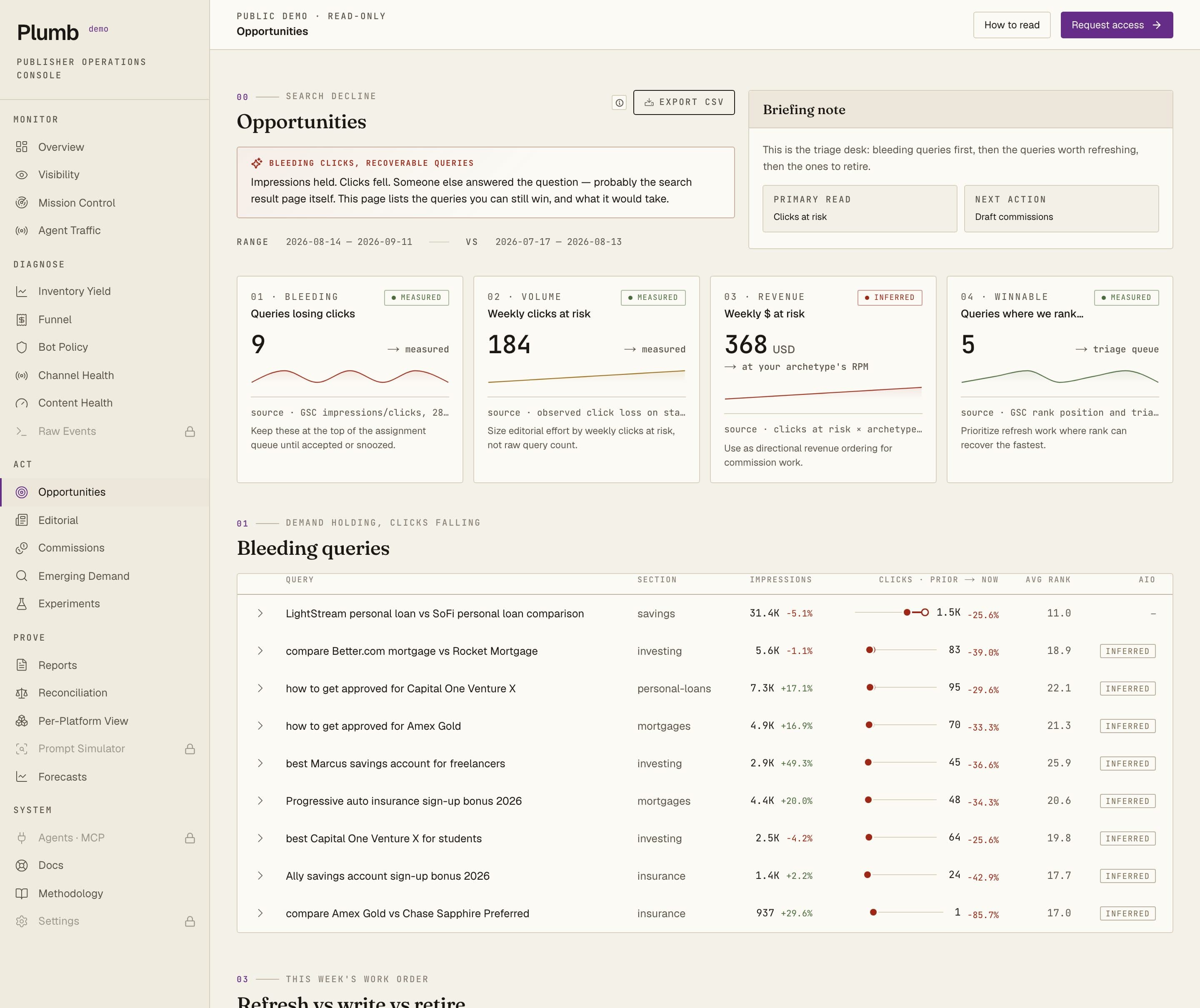
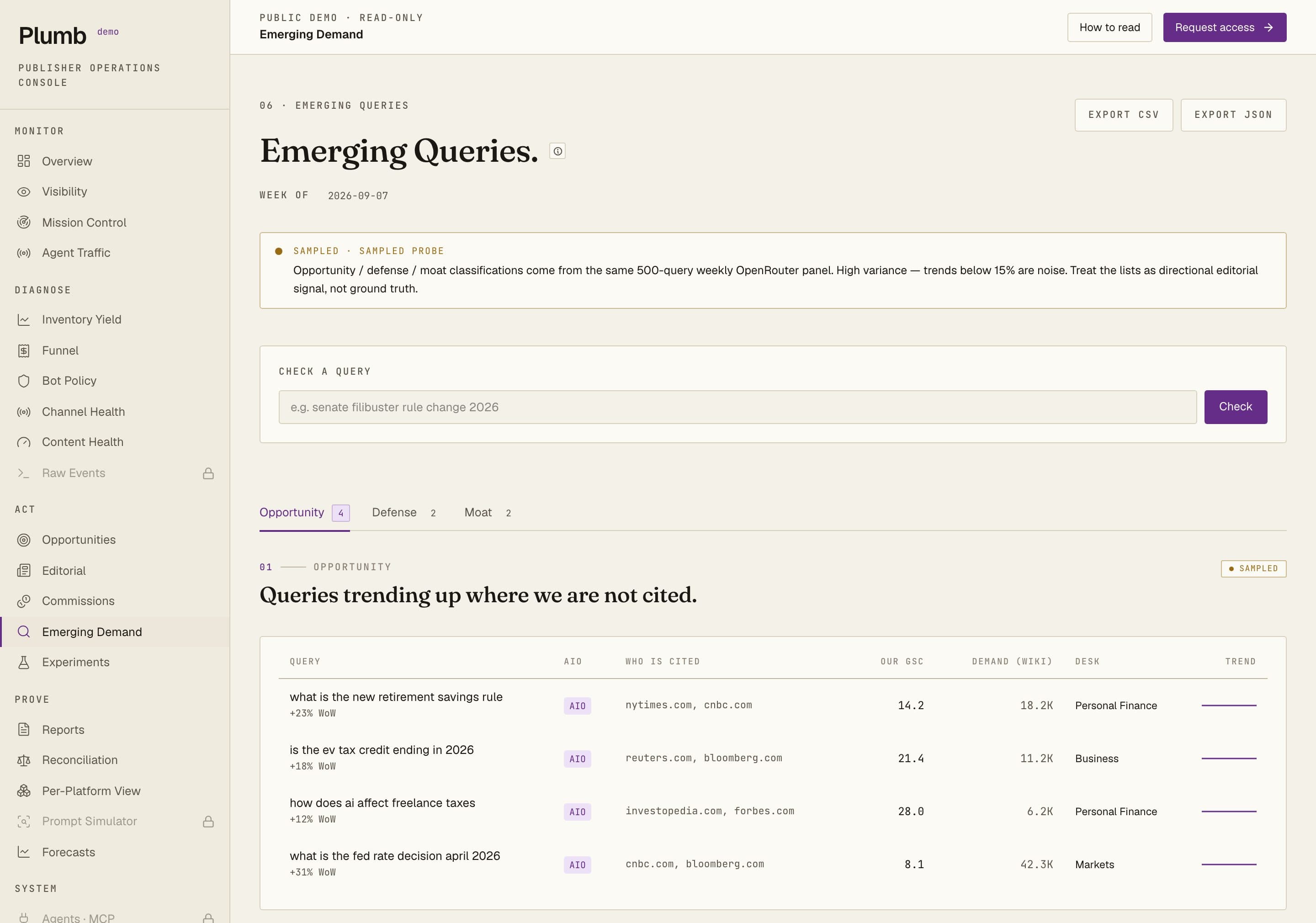
list_bleeding_queriesToolAI Overviews eating clicks, ranked by priority
get_article_healthToolCitability + structural diagnosis for one URL
list_bot_crawlersToolCrawlers hitting your content, policy state
get_visibility_panelToolShare of voice by platform, week over week
create_commission_draftToolDraft a commission from a query, brief attached
plumb://methodologyResourceMeasured / sampled / inferred, defined

+ 10 more tools, 4 more resources — see the full catalog in the console.

Prompt index

Questions editors actually ask.

The prompt set is a working index, not a slogan wall. Hover a row to see the reporting posture change when the evidence is already there.

  1. 01What changed in AI citations this week?on file
  2. 02Which topics lost referral share?on file
  3. 03Where are competitors replacing us?on file
  4. 04Which prompts trigger premium intent?on file
  5. 05What content should be refreshed now?on file
  6. 06Which crawlers need policy updates?on file
  7. 07What is MEASURED vs inferred?on file
  8. 08Which briefs deserve a commission?on file

Buyer fit

Who this is built for, row by row.

A capability matrix, not a comparison block. Each line ties a buyer type to the telemetry or workflow Plumb can actually support.

StatusBuyerClaimSource
Built forCommerceArticle-level economics and affiliate revenue.Revenue loop
Built forB2B mediaPaid newsletter or subscription LTV.Publisher model
Built forRevenue opsAudience, SEO, product, and editorial planning.Shared evidence
Built forInstrumentedCloudflare, Fastly, GSC, GA4, or server logs.First-party data
Not built forBrand sentimentGeneric share-of-voice dashboards.No revenue loop
Not built forContent farmsAutonomous article generation workflows.Wrong buyer
Not built forGeneral newsNo article-level revenue loop to close.No commission path
Not built forMarketplace-onlyNo first-party telemetry to reconcile.Missing source data

Schedule a field test

Publisher insights on AI agents.

Connect your logs and analytics, choose the evidence tier you trust, then send a report your editorial, product, and revenue teams can actually use.

Questions that usually arrive first.

Cloudflare, Fastly, GA4, GSC, or server logs. The more first-party surface area, the stronger the measurement.

No. Plumb verifies marketplace behavior with or without one.

Measured comes from systems you own. Sampled comes from probes. Inferred comes from modeled relationships.

No. It is for publisher revenue operations and editorial decisions.

Yes. Briefs, policies, and audit-grade evidence are designed to move outside the product.

No. It gives teams a clearer instrument for making the calls they already own.